
Workplace Emergency Response: CPR Training, AEDs & Action Plans
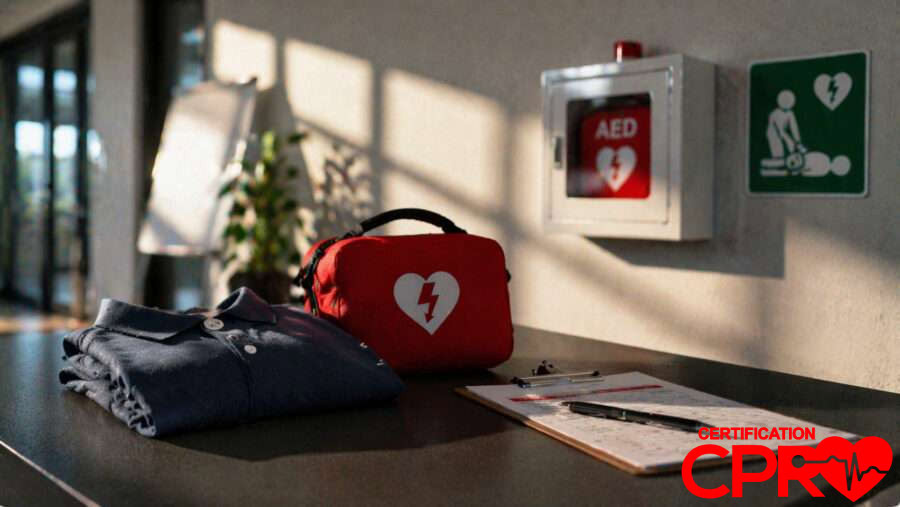
Most workplace emergency plans do not fail because nobody cares. They fail because the pieces live in different places: the AED is on the wall, the first aid kit is in a cabinet, the policy is in a binder, and the people who would respond have never practiced together.
A stronger plan gives names and roles before the emergency starts. One person calls 911, one person starts CPR, one person brings the AED, and one person clears space for responders. Everyone knows where the AED and first aid kit live, and the plan is built around the actual rooms, entrances, and work areas employees use every day.
Tampa workplaces range from hospital floors and clinics to Westshore offices, USF buildings, schools, restaurants, hotels, Port Tampa Bay operations, Raymond James Stadium events, and MacDill-adjacent support roles, so emergency plans have to match the building and the people who are actually there.
When someone collapses, the first response team is whoever is already inside. Outside help may be on the way quickly, but the people in the building still own the first minutes. That is where CPR training, AED access, and a usable action plan have to meet.
Upcoming CPR Class Dates and Times
The Importance of CPR Training in the Workplace
Workplaces are full of ordinary days until one is not ordinary anymore. A sudden collapse on a warehouse floor, in an office break room, beside a reception desk, or during a staff meeting can turn into a cardiac emergency in the minutes before outside help gets there.
CPR training matters at work because the people already in the building shape the first few minutes, whether they signed up for that role or not. Many workplaces also need a clear first aid plan, trained responders, and supplies that match the hazards on site. Exact workplace safety expectations should be confirmed with the employer, safety lead, or applicable regulator.
Hands-on training gives employees more than awareness. It gives them a sequence they can use: call 911, start CPR, get the AED, and keep the response moving until EMS takes over. The order matters because a workplace emergency can quickly become noisy, crowded, and emotionally hard to read. Training gives employees something steadier than instinct.
A trained employee is also more likely to notice the difference between normal breathing and gasping, understand why compressions should start quickly, and know how the AED fits into the response. Those decisions keep the response moving instead of leaving coworkers gathered around a person on the floor, waiting for someone else to act.
The best workplace programs do not depend on one heroic responder. They train enough people across shifts, departments, and coverage areas that the plan still works on a busy afternoon, a holiday week, or a day when the usual safety lead is out.
Creating a Workplace Emergency Action Plan
A workplace emergency action plan should answer the obvious questions before an emergency ever tests it. Who calls 911? Who starts CPR? Who gets the AED? Where is the first aid kit? Which entrance should EMS use, and who is meeting them there?
A workable plan is short enough to remember and specific enough to use. Vague policy pages do not help when nobody knows who is in charge. A strong plan names the actions that have to happen in parallel, not just the policy goal. Calling 911, starting CPR, retrieving the AED, directing EMS, and keeping bystanders back are separate jobs, and a single employee usually cannot do all of them well at the same time.
The plan should also fit the building. A two-story corporate office has different AED placement and coverage needs than a large warehouse, a school with multiple wings, or a clinic with front and back entrances. If the AED is far from the most populated work area, if the main entrance locks after hours, or if EMS would naturally arrive at the wrong door, the plan has to account for that before the emergency starts.
Good plans also survive normal staff movement. New employees join, shift leads change, departments move, and renovation work can alter the fastest route through a building. A plan that made sense last year may need updating if the AED moved, the front desk procedure changed, or the trained employee everyone relied on took a different role.
Walk the plan from the point of view of the first employee who finds the person. Can they call for help without leaving the person alone? Does someone nearby know where the AED is? Can EMS get to the right door? If the answer depends on luck, the plan still needs work.
Why Your Business Needs AEDs
An AED gives the workplace a tool for the first few minutes of sudden cardiac arrest. It checks the heart rhythm and tells the rescuer whether a shock is advised. The device does not replace CPR training, but it gives trained employees a way to bring defibrillation into the response before EMS arrives.
Cardiac arrest is a time problem. CPR helps keep blood moving, but an AED may need to get into the response fast when a shockable rhythm is present. If the device is three hallways away, locked in an office, or known only to one manager, the workplace has the equipment without the access that makes it useful.
An AED only helps if it is accessible, visible, and familiar to the people who may have to grab it. Employees do not need to become rhythm experts. They do need to know where the AED is, how to turn it on, how to clear the person during analysis and shock, and why CPR resumes after the device gives its prompt.
Placement should match real traffic. A device near the lobby may make sense for a small office. A larger workplace may need to think about distance from production areas, fitness rooms, classrooms, staff areas, or customer-facing spaces. The device has to be close enough, visible enough, and familiar enough for someone to get it to the person quickly during a bad moment.
Workplace AED Readiness Checklist
Readiness basics are simple: the AED is easy to find, easy to reach, and not locked behind a system nobody remembers under pressure. The device should be visible enough that employees can describe its location without walking around to look for it.
The battery and pads need to be current. The area around the unit should stay clear. Staff should know where it is and who is expected to grab it during an emergency. If the workplace uses after-hours access codes, badge doors, elevators, or multiple floors, those details should be part of the plan.
One person or one role should also own the readiness checks. If everyone assumes someone else owns it, small problems sit until an emergency surfaces them. The owner does not have to be the only person trained to respond; the owner simply keeps the equipment from becoming forgotten furniture.
- Confirm the AED location is visible and easy to explain.
- Check pad and battery dates on a regular schedule.
- Keep the cabinet, sign, and floor area clear.
- Make sure more than one employee per shift knows where the AED is.
- Review the fastest route from the AED to the busiest work areas.
- Assign someone to meet EMS at the right entrance.
A checklist should lead to action, not just documentation. If employees cannot answer where the AED is, who calls 911, who retrieves the device, and how EMS gets in, the next staff meeting or safety training should fix those gaps.
Where Onsite CPR Training Fits
Training is where the plan stops being theoretical. A written emergency plan can assign roles, but employees still need to practice the sequence: call 911, start CPR, bring the AED, clear the person for analysis, and keep the response moving until EMS arrives.
For groups, onsite CPR training can make sense because employees practice together in the same building where they would respond. The class can connect the CPR and AED sequence to the actual AED location, entrances, stairwells, front desk, security desk, or shop floor.
Onsite training also lets teams practice the handoff between people. One employee can be directed to call 911. Another can retrieve the AED. Another can clear space or guide EMS. The team does not need a perfect script; it needs enough rehearsal that the first moves feel familiar before those moves matter.
Upcoming CPR Class Dates and Times
For workplaces that want broader readiness, First Aid can sit beside BLS as supplemental training. First Aid does not replace the AHA BLS class when BLS is the card requirement, but it can help employees respond to bleeding, burns, allergic reactions, and sudden illness that may happen outside a cardiac arrest scenario.
The goal is a team that already knows what to do, not another safety binder that nobody opens when an emergency stops being theoretical. A plan is strongest when the people, the building, the AED, and the training all point in the same direction.